
Lawsuit against Armando Montelongo Rises above 420 Plaintiffs – Files in Texas Courts
“…in any financial market at any given time”
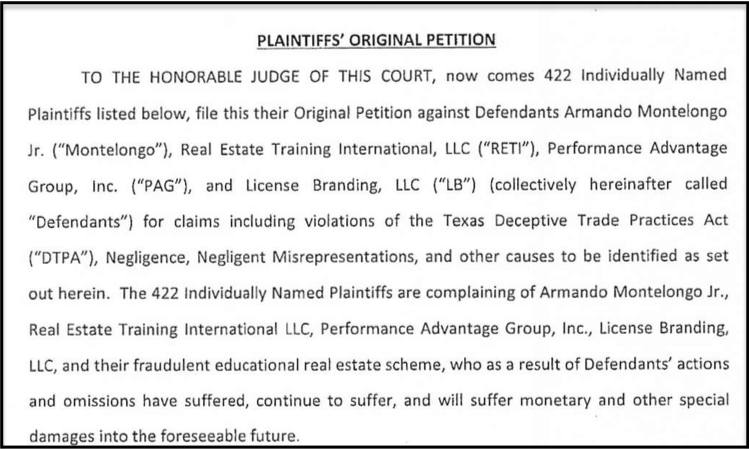
While the Federal Courts Dismissed the RICO case against Armando Montelongo last month, the plaintiff count continues to rise amidst the common theme of Deceptive Trade Practices, Negligence, and Negligent Misrepresentation, and has filed in Bexar County courts in Texas under case number 2018-CI-13094.
“To hide their deception, Montelongo and his employees instill fear in the students to discourage them from questioning the AMS system, and attack or silence those who attempt to speak out…”

Excerpts from the Case
“…before a bus tour event, Montelongo will use an affiliate to purchase properties in the area where the event will occur, and then, during the event, sell the properties to students at inflated prices without disclosing that he has an interest in the sales or receives a share of the profits. (One student, [redacted], fortuitously overheard Montelongo discussing this scheme when she dialed in early to a planned group call for AMS students.)”
“To hide their deception, Montelongo and his employees instill fear in the students to discourage them from questioning the AMS system, and attack or silence those who attempt to speak out. For example, early on in a group event, when someone asks a question, Montelongo will berate the speaker, deriding him or her for wasting the other students’ time. Cowed, few others will dare to interrupt again. At other points in an event, Montelongo will mention his in-house legal team, and claim that no one could possibly sue him and win. The crux of these remarks is that anyone who would cross Montelongo on a business deal would lose, and that any student who would cross him would lose, too.”
“Former employees report that Montelongo coaches them to ensure the students ‘feel like they have received some content, but do not actually know what to do on Monday.’“
“Weinrich [representing allied IRA company] also permits Montelongo access to confidential information about the students’ finances that Defendants then use to prey upon them. Multiple former employees report that he shouts angrily, saying ‘That’s my moneyl You’re not doing your job to get that in my pocket!’. The employees comply, using their knowledge of the students [supposedly confidential] finances to sell them more AMS “education” or encourage them to invest in properties with AMS-allied developers.”
“Defendants also carefully monitor the private Facebook groups to which they invite their past and present students, immediately deleting anything critical of not only AMS or Montelongo, but also of anyone else who is a member of the group-even if that person is known to have cheated other students of money-and forcing out those who continue to dissent.”
“When pressed to prove their claims, Defendants have resorted to harassment. ln late 2013, the news show 20/20 taped an interview with a student who complained that she and her husband had been cheated by Montelongo’s seminars. Montelongo had her followed by a private investigator (as one of his employees later admitted). When Montelongo provided a student who was a ‘success story’ to the news show, that student began recounting the wealth he had earned by following the AMS system, and then broke down and admitted it was a lie. Montelongo pursued this student, too-calling him personally and demanding he sign a declaration affirming that he had been successful.”
“[…] Montelongo solicited large amounts of student money for an investment in a marina near Sarasota, Florida called the Olde Fish House Marina. lt may have reaped benefits for Montelongo-the AMS website describes it as a “successful casual dining establishment”-but the students who invested with him, including plaintiff [redacted], sustained heavy losses.”
“Defendants also harm students by encouraging them to work with AMS allies-“mentors” who are paid to provide the students with supposedly in-depth education and consultation on rehabilitating particular types of properties and changing market conditions, but who often lack the experience to provide inslght, take advantage of the students’ trust to enrich themselves, […] which frequently end in inadvertent disaster or outright embezzlement.”
“…Defendants refuse to take responsibility when those allies cause students harm. Some of these allies have even been criminally prosecuted for their conduct involving students; their identities will be revealed in the course of this case.”